
Camera inspection: $300–$750
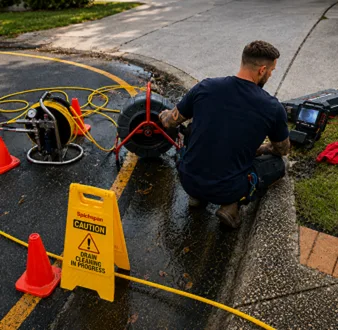
The first and non-negotiable step. Most operators credit it against the works if you proceed.
A cracked or root-damaged drain does not have to mean a trench through the garden. A resin liner is cured inside the existing pipe from an access point you already have, sealing every joint along the run, and the surface above is never touched.
Relining is a structural repair, not a cleaning method, and the distinction matters when you are comparing quotes. Jetting restores flow through a pipe that is still cracked. A liner restores the pipe.
That also means it is not always the answer. It cannot correct a run that has sagged or lost its fall, and it has nothing to line against where a section has collapsed. A camera survey separates those cases in about an hour, and the answer changes the cost by a multiple.
On stable ground a short patch over a single defect is often the proportionate repair. On reactive soil it frequently is not, because the movement that opened one joint has been working on every other joint in the same run for the same number of years.
That is worth knowing when you compare quotes. The cheaper patch can be the right call, but on this ground the full-length liner is more often the one that ends the problem rather than relocating it a metre.
Wareemba’s leafy interwar streets and mature gardens send roots hunting into old pipe joints, a top cause of recurring blockages here.
On a period property the drainage repair is rarely the expensive part. Tessellated verandah tiles, original brick paving, a mature garden or a heritage-listed frontage all cost far more to reinstate than the pipe underneath costs to fix.
That is the argument for trenchless in one sentence. The liner is drawn through an existing opening and cured in place, so the surface above is never disturbed and there is nothing to match, replace or explain to council.
Excavation close to the foreshore brings problems that have nothing to do with plumbing: unstable saturated ground, dewatering, restricted access down a narrow lot, and reinstatement of landscaping that was not cheap to build.
The trenchless comparison is not repair against repair. It is repair against repair plus everything sitting on top, and on a waterfront block that second half is usually the bigger number.
Once is weather. Twice is a defect, and the second event is the point at which paying for a camera saves money rather than costing it.
What we are looking for is specific: a belly holding water, a joint that has opened, a section crushed by a vehicle crossing. Each has a different answer, and only one of them is relining. Knowing which you have is worth more than another clear.
Root intrusion is not automatically a relining job. If the roots are fine and the pipe behind them is sound, a cut and jet with a maintenance interval can be the right call for years.
What moves it to relining is structural: an open joint you can see daylight through, a cracked barrel, or a run that has been cleared repeatedly at shortening intervals. Anyone quoting a liner without showing you the inside of the pipe is guessing, and you should ask for the footage.
Decades of ground movement on established blocks pull old pipe joints apart, opening gaps that invite blockages and leaks.
Reactive clay soil moves with the seasons, lifting in the wet and shrinking back in a dry spell. Rigid drainage laid through it gets flexed every year, and the joints are where that movement is absorbed until they stop absorbing it.
It is the reason drainage faults on these soils cluster after a long dry followed by heavy rain. The pipe did not fail that week; it finished failing that week.
The first and non-negotiable step. Most operators credit it against the works if you proceed.
Domestic sewer across Sydney in 2026. Longer single runs sit at the lower end of it.
Seals one defect. Right where the rest of the run is sound and the ground is stable.
Length, diameter and how many branches need reinstating are what move the number inside that band.
Excavation is only half the cost. Replacing the driveway or garden above it is the other half.
Indicative Sydney ranges for 2026. Your job is quoted in writing after the camera survey. Figures here are indicative of the 2026 Sydney market rather than a quote from us, you get your own number as a fixed price before any work starts.

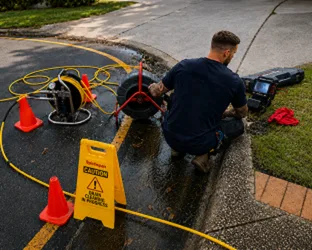
A CCTV survey establishes the material, the diameter, where the defects are and how far they sit from the access. You see the footage, and it is what the quote is built from.
Patch or full length, and occasionally excavation instead. We will tell you when digging is the better answer even though it is the bigger quote.
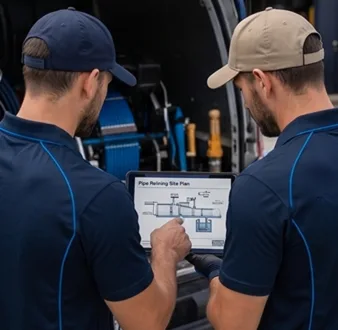
The run is jetted so the liner bonds to pipe rather than debris, the liner is installed through the existing access, and it cures in place. Most domestic jobs are a single day.

Every branch the liner passed is reopened from inside, then the run is cameraed again so you can see it is continuous and the junctions are clear.
Describe what the drain is doing and how often. We will tell you whether it sounds structural or whether a clean and a maintenance interval is the honest answer.
The questions that come up before every relining job, answered with real numbers.

Call for the fastest answer, or send the form and we will arrange a camera survey before anything is quoted.

Leave your details and our local Wareemba team will call you back fast.